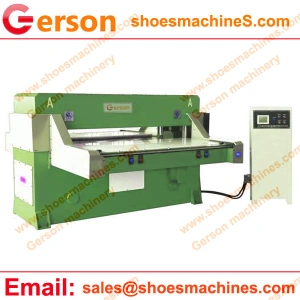
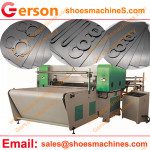
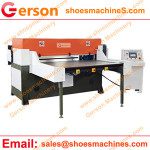
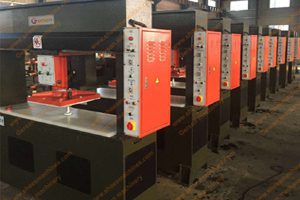
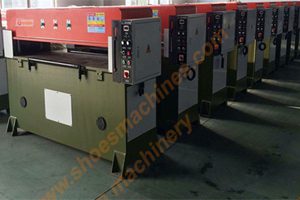
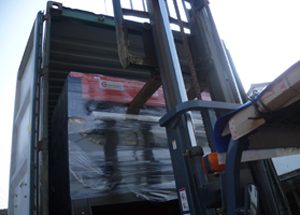
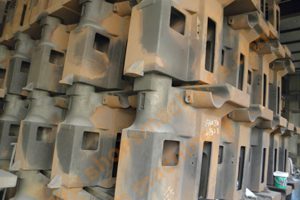
An 80-ton beam press is a powerful industrial machine designed to apply 80 tons of pressure for various operations on both sheet and roll materials. These hydraulic presses are essential for both low and high-volume production across a wide range of industries.
80 ton Beam Press for Sheet or Roll Material
A beam press operates by using a “beam” or “cutting head” to apply immense pressure to a material, which is typically positioned on a cutting bed or table. The material is then processed against a cutting die or specialized tooling.
Hydraulic System:Gerson 80-ton beam presses are hydraulic. They generate force by pressurizing oil and transmitting it to a larger piston, creating the necessary pressing power.
Movement:
In a “fixed beam” press, the cutting head moves vertically (up and down), while the material is fed underneath using mechanisms like slide-in tables, roller feeds, clamping bar drives, or punching belts.
“Traveling head” presses feature a head that can move across the entire cutting bed, offering greater flexibility.
“receding head” press, also known as a receding beam press or receding head die-cutting machine is that the cutting head (or beam) moves backward or “recedes” after each cutting cycle, completely exposing the cutting area.
Dies and Tooling: The specific operation performed (such as cutting, bending, forming, or punching) depends on the dies and tooling attached to the press. These can be easily swapped out to accommodate different applications.
Control Systems: Gerson CNC beam presses often come equipped with CNC (Computer Numerical Control) systems. These systems enhance precision and automation, allowing for programmable stroke adjustments, precise pressure control, and even automatic die setting. Many higher-tonnage presses also include crowning systems to prevent beam deflection and ensure consistent results across the material’s length.
Key Specifications
While specifications can vary between manufacturers and models, here are some common features of an 80-ton beam press:
Tonnage: 80 Tons (Gerson have mini beam press 10 ton to Large beam press 10000 ton)
Cutting Area/Bed Size: This varies significantly, but common sizes range from 30″ x 30″ up to 78″ x 36″ or even larger, depending on the specific model and type (full beam, receding head, or traveling head).
Stroke: The vertical travel distance of the cutting head, often adjustable (e.g., 1.5″ – 7.75″ or up to 285mm).
Power: Typically requires 3-phase, 220V/380/415V, 50Hz/60Hz power, with motor power generally ranging from 7.5 kW to 10 kW or more.
Dimensions and Weight: These machines are substantial, often weighing 9,000 lbs (4,000 kg) or more.
Features: Many models include safety features like dual operator push buttons, pressure gauges, adjustable stroke and pressure controls, back gauges, and options for both manual and automatic operation.
Applications for Sheet or Roll Material:
An 80-ton beam press is highly versatile and used for a wide range of tasks on various materials, including:Die Cutting: This is a primary application, especially for materials like:Leather,Rubber,Plastics,Textiles,Foam,Gasket materials,Paper and cardboard,Carpet,Flooring,Cork,Felt,Electronics components.
the following table outlines common features:
Specification
Typical Range / Details
Notes
Tonnage
80 Tons ( 800 kN)
This is the maximum force the press can exert. The actual required tonnage will depend on the material type, thickness, and the complexity of the cut/form.
Cutting Area/Bed Size
Varies significantly, common sizes from 30″ x 30″ (762 x 762 mm) up to 78″ x 36″ (1981 x 914 mm) or larger. For receding head presses, larger bed sizes (e.g., 63″ x 31.5″ or 1600 x 800 mm) are common due to the open access.
This refers to the usable area where material can be processed. Consider the maximum size of your parts or rolls. The type of press (full beam, receding head, traveling head) greatly influences available bed dimensions.
Stroke
Often adjustable, ranging from 1.5″ – 7.75″ (approx. 38 – 197 mm) or up to 285mm. Some models may have a larger range, e.g., 0-140mm for receding head.
The stroke is the vertical travel distance of the cutting head. An adjustable stroke allows for versatility in accommodating different die heights and material thicknesses, optimizing cycle time.
Daylight (Open Height)
Typically ranges from 7.75″ up to 20″ or more, depending on the stroke and machine design.
This is the maximum vertical clearance between the cutting head (in its uppermost position) and the cutting bed. It’s crucial for accommodating taller dies and material stacks.
Motor Power
Generally ranges from 7.5 kW to 10 kW (approx. 10 HP to 14 HP) or more.
The motor powers the hydraulic pump. Higher motor power often correlates with faster cycle times and the ability to handle more demanding operations.
Power Requirements
Typically 3-phase, with common voltage options like 220V, 380V, 415V, and frequencies of 50Hz or 60Hz, depending on the region. Operating Amps typically 35A. Startup Amps can be higher (e.g., 180A).
Ensure your facility’s electrical supply matches the press’s requirements. Consider the startup amperage for electrical infrastructure planning.
Dimensions (L x W x H)
Highly variable, but these are substantial machines. Example: 90.5″ L x 86.6″ W x 78.7″ H (approx. 2299 x 2200 x 1999 mm) for an 80-ton receding head press.
These refer to the overall physical footprint of the machine. Critical for floor space planning and facility layout.
Weight
Often in the range of 9,000 lbs (4,000 kg) up to 15,000 lbs (7,000 kg) or more for the press unit alone. Power units can add another 1,000-2,000 lbs.
Important for determining floor loading capacity, rigging, and installation requirements. Heavier presses generally indicate a more robust and stable construction.
Control System
Manual, Semi-automatic, or Fully Automatic (often with CNC, PLC, or HMI touch screen control panels like Weintech).
Defines the level of automation and precision. CNC/PLC controls allow for programmable stroke, pressure, and sometimes automatic material feeding and die changing.
Essential for operator safety and compliance with industrial regulations. Light curtains provide an active safety barrier around the work area.
Additional Features
Adjustable pressure control, Back gauges, Automatic die setting, Die clamping systems, Manual/Automatic operation modes, Hydraulic fluid type (e.g., ISO 68), Remote diagnostics, Data logging.
These features enhance the machine’s efficiency, versatility, and ease of maintenance.