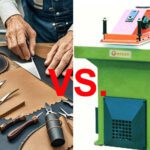
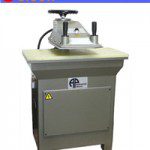
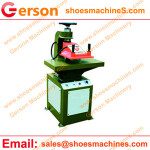
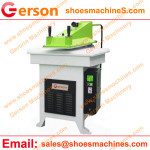
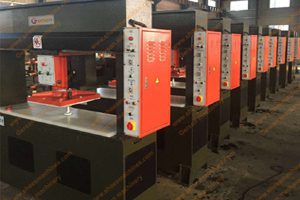
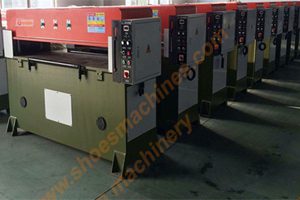
When it comes to clicker presses (also known as a die-cutting press or cutting press) is a machine used to cut shapes from various sheet materials quickly and efficiently using specialized cutting dies. The main distinction between “hand” and “hydraulic” lies in the mechanism used to generate the cutting force.
Hand Clicker Press (Manual Clicker Press)
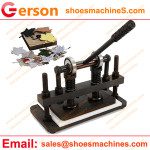
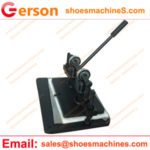
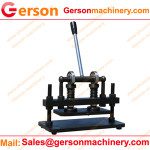
Hand Clicker Press
A hand clicker press relies on human effort and mechanical leverage to apply pressure to a cutting die.
Advantages:
Cost-Effective: Typically the most affordable option, making them popular for hobbyists, small workshops, or those just starting out.
Portability: Generally smaller and lighter than hydraulic presses, making them easier to move or set up in different locations.
No Power Required: Operates without electricity or compressed air, offering flexibility in placement and lower operating costs (no utility bills for the press itself).
Direct Control: The operator has direct tactile feedback and control over the pressure applied, which can be beneficial for delicate materials or specific embossing tasks.
Simplicity and Low Maintenance: Fewer complex parts mean less to break and easier maintenance.
Disadvantages:
Limited Force: The amount of force generated is limited by the operator’s strength and the press’s mechanical advantage. This restricts them to cutting thinner, softer materials or using smaller dies.
Fatigue: Repetitive manual operation can lead to operator fatigue, especially for higher production volumes.
Slower Production: Cycle times are slower compared to powered presses, making them less suitable for high-volume production.
Inconsistent Pressure (potentially): While an experienced operator can achieve consistency, it can be harder to maintain perfectly uniform pressure across many cuts compared to a machine.
Smaller Cutting Area: Manual presses often have smaller cutting beds, limiting the size of dies and materials they can accommodate.
Typical Applications:
Leather crafting (small items like key fobs, wallets, small bag components)
Fabric and textile cutting (thin materials)
Gasket cutting (light duty)
Prototyping and small batch production
Embossing with lighter pressure
Hydraulic Clicker Press
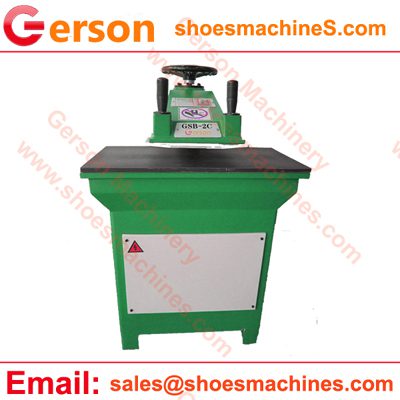
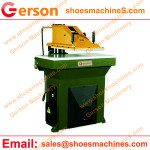
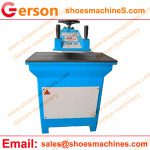
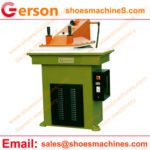
Hydraulic clicker presses use a hydraulic system (fluid pressure) to generate significant force, powered by an electric motor.
Hydraulic Clicker Press
Advantages:
High Force Capabilities: Can generate extremely high tonnage, allowing them to cut through thick, tough materials (like heavy leather, rubber, plastics, composites) and use larger, more complex dies.
Consistent and Uniform Pressure: The hydraulic system ensures consistent and evenly distributed pressure across the entire cutting area, leading to clean, accurate cuts every time, even with large dies.
Reduced Operator Fatigue: Operation requires minimal physical effort, typically just pressing a button or engaging a lever.
Higher Production Volume: Faster cycle times (compared to manual) and less operator fatigue make them suitable for medium to high-volume production.
Versatility: Can handle a wider range of materials and thicknesses, and are often used for applications beyond just cutting, such as embossing, forming, and even some light stamping.
Larger Cutting Area: Hydraulic presses often come with larger cutting beds, accommodating bigger dies and material sheets.
Disadvantages:
Higher Cost: Significantly more expensive to purchase than hand presses.
Requires Power: Needs an electrical power supply to run the hydraulic pump.
Maintenance: Involves more complex maintenance, including checking hydraulic fluid levels, hoses, and seals, and potential for fluid leaks.
Noise: Can be noisier due to the electric motor and hydraulic pump.
Larger Footprint: Generally larger and heavier, requiring more dedicated floor space.
Less Portable: Not easily moved once installed.
Typical Applications:
Heavy-duty leather goods production (bags, belts, saddlery)
Gasket manufacturing
Footwear components
Automotive interior components
Textile and apparel cutting (multi-layer or tough fabrics)
Medical devices
Any application requiring high force, precision, and consistent cuts on demanding materials or in higher volumes.
Key Differences Summarized:
Feature
Hand Clicker Press (Manual)
Hydraulic Clicker Press
Power Source
Human effort/mechanical leverage
Electric motor powering hydraulic fluid
Force Output
Lower to moderate (e.g., 1.5 – 8 tons)
Very high (e.g., 12 – 100+ tons)
Speed
Slower, depends on operator
Faster cycle times
Precision
Good for small dies, can vary with operator
Excellent, consistent, and uniform
Cost
Lower initial cost
Higher initial cost
Maintenance
Very low, simple
More complex (fluid, seals, pump)
Portability
High
Low
Volume
Low to medium production
Medium to high-volume production
Materials
Thinner, softer materials
Thick, tough materials; multi-layer cutting
Noise
Minimal
Can be noisy (motor/pump)
Related Products:
Hand Operated Clicker Press Gerson Hand operated clicker press is manual hand die cutting press machine that used for…