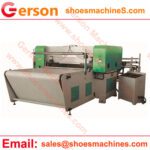
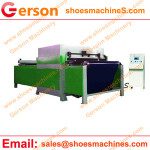
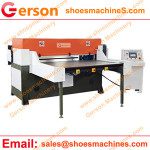
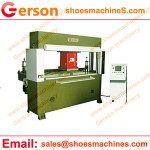
Mini Beam Platen Press with Conveyor Feeding System
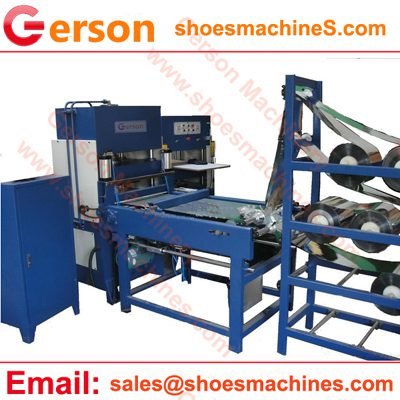
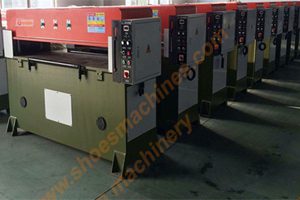
Mini Beam Platen Press with a Conveyor Feeding System is The advanced die-cutting system combines the precision of a Gerson hydraulic mini beam press with the efficiency of an integrated conveyor belt feeding mechanism. It represents a significant step towards full automation in material processing, ideal for high-volume production.
Mini Beam Platen Press with Conveyor Feeding System
Key Features:
Hydraulic Mini Beam Press Core:
Precision Cutting Force: Utilizes a powerful hydraulic system to deliver consistent and precise downward pressure, ensuring clean and accurate cuts through various non-metallic materials.
Platen Design: Features flat upper and lower platens for even pressure distribution across the cutting die, crucial for material integrity and consistent results.
“Mini” Designation: Typically indicates a compact footprint and a tonnage range (e.g., 10-100 tons, though custom options exist) suitable for a wide array of products without requiring the massive scale of larger beam presses.
Adjustable Stroke and Tonnage: Allows for fine-tuning of cutting parameters to match specific material thickness and die requirements, minimizing wear on dies and cutting surfaces.
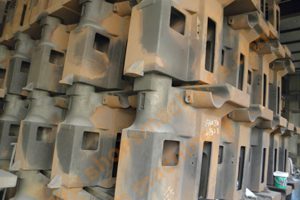
Robust Construction: Built with heavy-duty, torsion-resistant welded frames for durability, stability, and long operational life in demanding industrial environments.
Integrated Conveyor Feeding System:
Automated Material Infeed and Outfeed: A continuous conveyor belt moves rolled material or sheets into the cutting area, positions it precisely, and then transports the cut parts and waste away.
Servo-Driven Accuracy: Often powered by servo motors, the conveyor system provides highly accurate material indexing and repeatable positioning, essential for precise cuts and minimizing waste, especially for printed materials or multi-part nesting.
Synchronization with Press: The conveyor’s movement is seamlessly integrated and synchronized with the press’s cutting cycle, creating a continuous flow of production.
Roll or Sheet Handling: Capable of feeding material directly from large rolls or automatically handling pre-cut sheets, offering flexibility in material input.
Waste Removal: The conveyor efficiently removes skeletal waste, simplifying the post-cutting process and maintaining a cleaner work area.
Advanced Control Systems:
HMI Touch Screen Interface: Intuitive human-machine interface (HMI) with a touch screen for easy setup, operation, and monitoring of press parameters.
PLC/CNC Control: Programmable Logic Controller (PLC) or Computer Numerical Control (CNC) ensures precise control over cutting depth, material advancement, speed, and complex pattern nesting.
Recipe Saving Functionality: Allows operators to store and recall specific job settings (e.g., tonnage, stroke, feed length) for quick changeovers and consistent quality across different production runs.
Diagnostic Capabilities: Built-in diagnostics for troubleshooting and maintenance, reducing downtime.
Safety Features:
Light Curtains: Infrared safety light curtains prevent press operation if an object or person breaks the beam, ensuring operator safety.
Emergency Stop Buttons: Strategically placed emergency stop buttons for immediate shutdown in critical situations.
Two-Hand Operation: Requires simultaneous activation of two buttons to initiate a cycle, preventing accidental operation.
Benefits:
Significantly Increased Productivity: The automated conveyor system eliminates manual material handling, leading to continuous operation, faster cycle times, and vastly higher throughput.
Reduced Labor Costs: Automation minimizes the need for direct operator intervention, freeing up personnel for other tasks and lowering labor expenses per unit.
Superior Cutting Accuracy and Consistency: Precise material feeding and consistent hydraulic pressure result in highly accurate and repeatable cuts, reducing material waste and ensuring product quality.
Minimized Material Waste: Advanced nesting capabilities (often via software integration) and precise feeding optimize material utilization, leading to cost savings.
Enhanced Operator Safety: Automated feeding keeps operators away from the cutting area during operation, significantly improving workplace safety.
Versatility in Material Processing: Capable of handling a broad spectrum of non-metallic materials, from thin films to thicker composites, in both roll and sheet forms.
Quick Changeovers: Recipe saving and automated adjustments facilitate rapid setup changes between different jobs, maximizing machine uptime.
Scalability: Can be integrated into larger automated production lines, with options for pre-feeders, rewinders, or robotic pick-and-place systems.
Applications:
The Gerson Mini Beam Platen Press with Conveyor Feeding System is ideally suited for industries requiring high-volume, precise die-cutting of flexible and semi-rigid materials. Common applications include:
Textile and Apparel: Precision cutting of fabric patterns, non-woven materials, technical textiles, and insulation for garments or industrial uses.
Gasket and Seal Manufacturing: High-volume production of various gaskets and seals from rubber, cork, foam, and composite materials.
Foam and Packaging: Cutting foam inserts for protective packaging, medical devices, or cushioning.
Leather Goods: Efficient cutting of leather for footwear, bags, and other accessories.
Abrasives: Die-cutting abrasive sheets, discs, and belts.
Medical and Cleanroom: Cutting specialized materials for medical disposables, filters, and cleanroom supplies where precision and hygiene are critical.
Consumer Products: Production of components for a wide range of consumer goods, including toys, electronics, and household items.
In essence, a Gerson Mini Beam Platen Press with a Conveyor Feeding System is a powerful, automated solution for manufacturers seeking to optimize their die-cutting processes for efficiency, accuracy, and high-volume output.If you want to buy one small automatic die cutting press ,Gerson Mini Beam Platen Press will be your good choice.
Mini Beam Platen Press with Conveyor Feeding System Specification:
Specification Feature
Typical Range / Example Value (Metric/Imperial)
Notes
Model
Gerson mini-GRB
Specific model name for this configuration.
Cutting Force (Tonnage)
20 – 100 US Tons (18 – 90 Metric Tons)
Determines maximum material thickness and hardness that can be cut.
Cutting Area / Platen Size (X x Y)
24″ x 36″ to 36″ x 60″ (610 x 915 mm to 915 x 1525 mm)
Defines the maximum size of the cutting die or material section it can process.
Max Stroke
4″ – 8″ (100 – 200 mm)
Maximum travel distance of the cutting platen. Adjustable for different die heights.
Cycles per Minute (No Load)
15 – 40 cycles/min
Indicates the theoretical maximum speed of the press.
Conveyor Belt Width
24″ – 60″ (610 – 1525 mm)
Should match or exceed the press’s cutting area width.
Max Feed Length (Index)
30″ – 100″ (760 – 2500 mm) or Continuous
Maximum distance the conveyor can advance material in one cycle.
Feed Accuracy / Repeatability
+/- 0.005″ ( +/- 0.125 mm)
Critical for precise cuts, material nesting, and minimizing waste.
Max Roll Weight Capacity
500 – 2,000 lbs (225 – 900 kg)
If the system is designed to handle large rolls of material.
Control System Type
PLC / CNC with HMI Touch Screen
Advanced controls for precision, programmability (e.g., job recipes), and user interaction.
Power Requirements
208V/230V/480V, 3 Phase, 50/60Hz
Essential for electrical installation; must match facility power.
Overall Dimensions (L x W x H)
Varies significantly by model, includes conveyor length.
Critical for planning floor space and layout in your facility.
Machine Weight
8,000 – 30,000 lbs (3,600 – 13,600 kg)
Important for shipping, rigging, and ensuring adequate floor loading capacity.
Safety Features
Light Curtains, E-Stop, Dual Controls
Standard safety measures to protect operators during machine operation.
Compliance
CE, OSHA (if applicable)
Indicates adherence to relevant safety and quality standards.