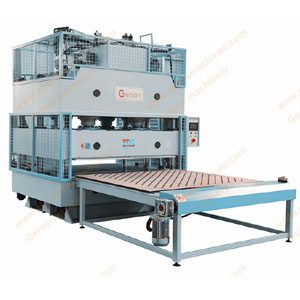
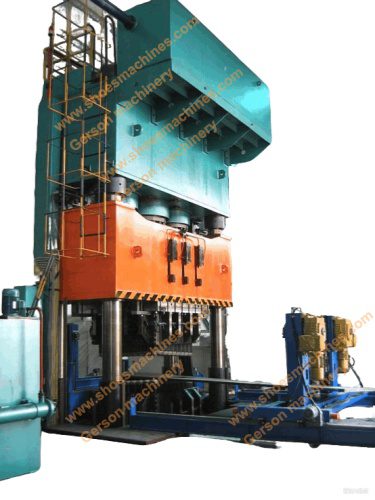
Hyperbolic Metal Sheet Forming Machine

Manufacturer & Supplier
38+ Years

Breakthrough Technology Using Multi-point
Fully Automatic Multi-curved Bending
Full Support on Installstion&Traning

Multi-point Press Forming Machine Leading Manufacturer

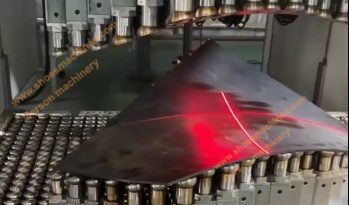
Gerson has developed the  multi-point hyperbolic forming machine that integrates mechanical, electrical, hydraulic, control, and optical breakthrough technologies. This cutting-edge equipment uses a ” multi-point punch-adjustable flexible die for sheet metal bend forming” method, allowing for the precise and automated creation of complex, multi-curved shapes from materials like aluminum,PEEK and stainless steel etc.,

This groundbreaking press represents a significant technological leap in the field of double-curved or hyperbolic bending. By establishing a unified data source that runs from the design phase to the final processing, it streamlines the entire workflow for metal shaping. In fact, this is one of the few systems worldwide to be widely used for the digital cold forming of ship hulls, showcasing its large-scale applicability and advanced capabilities.

Hyperbolic Forming Press Features & Specification

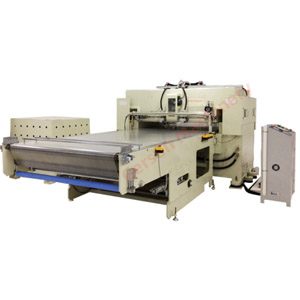
Hyperbolic Metal Sheet Forming Press

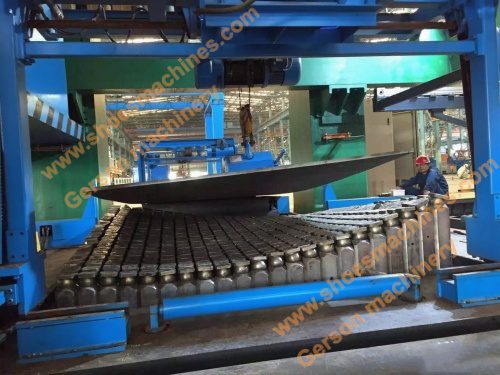
  • Multi-Point Forming: The machine is equipped with multiple independently controlled punches or die points that can be adjusted in real-time to match the workpiece shape, accommodating various curved surface requirements.
  • Double Curvature Forming: It is capable of processing double-curvature surfaces, making it suitable for complex geometric shapes.
  • High Precision: Computer control ensures high forming accuracy and consistency.
  • Flexibility: Without the need for traditional dies, it reduces tooling costs and production cycles, making it suitable for small-batch, multi-variety production.
  • Automation: It typically integrates automation systems to enhance production efficiency and product quality.
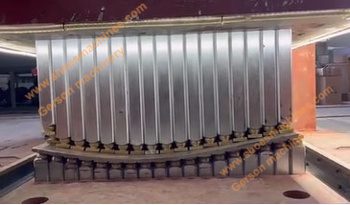
Metal plate forming press machine
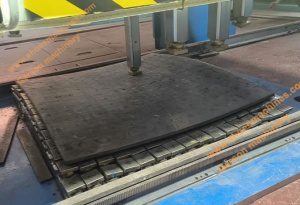
Steel plate curved forming press machines
Metal plates punch multi-point bending forming press

Multi-point Forming Machine Video

ModelGersonHMFM
Max. Plate Width (B)mm3000
Max. Plate Thickness (T)mm30 ( 1,2,3,4,5,10,20,30)
Max. Plate Length (L)mmCan custom built 
Plate Forming ShapeAny shapeSaddle, conical, and other 3D curved surfaces plates
Material Yield StrengthN/mm²235, 345
Transverse Bending Radius (r)mmR≈0.9×B (where B is the actual plate size)
Square Punch Head Sizemm(105-195)×(105-195)
Number of Upper Punch Heads (Hydraulic Drive)pcs20×20
Overall Width of Upper Diemm1680-3150
Number of Lower Punch Heads (Servo Motor Driven )pcs21×21
Hydraulic System Working PressureMPaMax. 20

Hyperbolic Metal Sheet Forming Machine Application

Material & Industry in Application

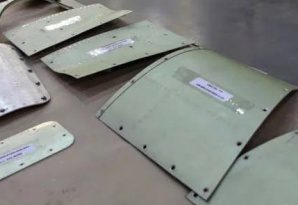
Aircraft skin forming press machine
Aircraft skin forming
  • Aircraft Skin Forming:  aircraft skin with complex curvature, such as fuselages and wings,
  • Spacecraft Components: structural components with complex shapes for spacecraft shells and fuel tanks
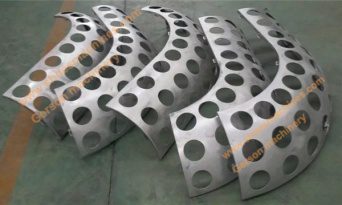
hyperbolic aluminum veneer forming
  • Complex Curved Architectural Components: Used to produce non-standard curved components for building facades, domes, and decorative panels, such as the unique structures found in museums and exhibition halls.
  • Artistic Sculptures: Manufactures large-scale artworks or decorative pieces, fulfilling the needs for complex shapes.

Shipbuilding and Marine Engineering
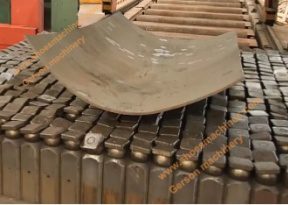
Ship hull forming
Ship hull forming
  • Marine Hull Plate Forming:Used for forming the curved surfaces of ship hulls, especially for the complex curved components of large vessels.
  • Offshore Platform Components: Produces non-standard curved structures for marine engineering equipment.

Medical and Bioengineering
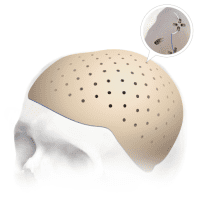
PEEK plate for cranioplasty manufacturing
  • Medical Devices: Manufactures personalized implants (e.g., bone repair plates) or medical device casings, adapting to specific patient needs.
  • Rehabilitation Equipment: Produces ergonomically complex shaped components.Automotive Manufacturing
  • Body Panels: Multi-point forming can quickly produce prototypes or small batches of external body panels (e.g., hoods, doors), shortening the development cycle.
  • Components: Supports personalized body designs to meet market demand.
  • Energy Equipment:manufacture: complex curved molds for wind turbine blades and produces large, high-precision curved components required in nuclear equipment.
  • Rapid Prototyping: Used for quick prototyping during the product development phase to verify design feasibility.
  • Flexible Molds: Replaces traditional rigid molds, reducing mold manufacturing costs and making it suitable for small-batch, multi-variety production.
  • High-Speed Train Components: Manufactures the streamlined shells of high-speed train heads or complex curved components for carriages, improving aerodynamic performance.
  • Subways and Light Rail: Produces lightweight, complex shaped components for vehicle bodies.
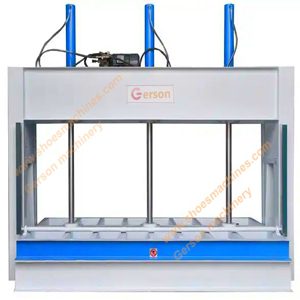
Gerson Hyperbolic Metal Sheet Forming Machine FAQ Guide

Updated on Aug 10th 2025

A hyperbolic metal forming machine is a specialized piece of equipment designed to create complex, three-dimensional, curved shapes in sheet metal. Unlike traditional stamping presses that use a single, solid mold, these machines often use multi-point forming technology.

Multi-point forming is an advanced manufacturing technology that discretizes a traditional monolithic die into a regular array of  punches. By computer-controlling the position and height of these punches, a flexible die is created to achieve three-dimensional curved surface forming of metal sheets. So Gerson Multi-point forming machine can precisely press a flat sheet of metal into a desired shape, such as a hyperbolic or “saddle” curve, without the need for a dedicated, fixed mold.

The sheet metal moldless multi-point forming is an innovative manufacturing method that uses computer-aided design and manufacturing (CAD/CAM) to shape sheet metal. Instead of a single, solid die, Multi-point forming machines use a reconfigurable “die or punches” made up of many small, height-adjustable pins. Each punches is individually controlled by a computer, allowing the machine to quickly create a custom forming surface.

This flexible approach eliminates the need for expensive, traditional molds, making it possible to rapidly produce complex, three-dimensional curved parts. The ability to form parts without a dedicated mold is a significant advancement in the production of sheet metal components.

Multi-point forming (MPF) is a modern manufacturing technique that offers several key advantages, particularly when compared to traditional stamping and forming methods. Its primary benefits stem from its flexibility and digital control.

1. Cost and Time Savings
  • No Dedicated Molds: The biggest advantage is the elimination of expensive and time-consuming custom-made dies molds. Traditional stamping requires a unique, rigid mold for every new part, which is a major expense for prototyping or small-batch production. MPF’s reconfigurable die, made of a matrix of punches, can be adjusted digitally, drastically reducing tooling costs and setup time.

  • Rapid Prototyping: MPF is ideal for rapid prototyping and low-volume production because the time to create a new part is simply the time it takes to input a new digital design and reconfigure the punches. This allows for quick design iterations and faster time-to-market.

2. Flexibility and Adaptability
  • Versatile Design: The reconfigurable nature of the multi-point die allows for the creation of a wide variety of complex, double-curvature shapes, including hyperbolic surfaces, that would be difficult or impossible to achieve with traditional methods.

  • Digital Integration: The entire process is controlled by a computer, integrating with CAD/CAM software. This enables precise and repeatable control over the forming process, making it easy to produce different parts on the same machine without any physical changes to the tooling.

3. Improved Part Quality
  • Enhanced Formability: Some studies have shown that multi-point forming can improve the formability of certain sheet metals, allowing for more severe deformations without cracking. This is often attributed to the unique stress distribution created by the multiple points of contact.

  • Reduced Springback: In some cases, MPF can reduce the amount of springback (the elastic recovery of the material after forming), leading to better dimensional accuracy of the final part.

Gerson Multi – point Press Forming (MPF) machine are versatile and can handle a wide range of materials, especially those suitable for sheet metal forming. The specific materials they can form include:
Metallic Materials
  • Ferrous Metals:
    • Carbon Steel: Including low – carbon steel (mild steel), which is widely used due to its good formability and relatively low cost, suitable for manufacturing various structural parts.
    • Alloy Steel: Such as high – strength low – alloy (HSLA) steel, which offers higher strength and is often used in automotive and aerospace industries where strength is a key requirement.
    • Stainless Steel: Both austenitic (e.g., 304, 316) and ferritic stainless steels, known for their corrosion resistance, are formable with MPF machines, used in kitchenware, medical equipment, etc.
  • Non – Ferrous Metals:
    • Aluminum and Aluminum Alloys: Like 6061, 5052, which are lightweight and have good formability, commonly used in aerospace, automotive, and consumer electronics.
    • Copper and Copper Alloys: Such as brass and bronze, valued for their electrical conductivity and malleability, used in electrical components and decorative parts.
    • Titanium and Titanium Alloys: With high strength – to – weight ratio and corrosion resistance, they are formed by MPF machines for aerospace and medical applications, though requiring more precise control due to their higher strength.
Non – Metallic Materials (Under Specific Conditions)
  • Plastics: Some thermoplastic sheets, such as polycarbonate,PEEK and acrylic, can be formed using MPF machines when heated to their softening point, suitable for making covers and light – related components.
  • Composites: Certain composite materials, like fiber – reinforced plastics (FRP), can be shaped by MPF machines, especially in the manufacturing of parts for the automotive and aerospace sectors where complex shapes are needed.
The ability of an MPF machine to form a particular material depends on factors such as the material’s thickness, mechanical properties (e.g., yield strength, elongation), and the machine’s capacity (e.g., forming force, punch adjustment range). Generally, materials with good ductility and formability are more easily processed by MPF technology, while high – hardness or brittle materials may require specific process adjustments or pre – treatment.

Structural Components:

  • Punch Array: Composed of a large number of regularly arranged punches, this is the component that directly contacts and shapes the sheet metal. The height of each punch can be controlled independently.

  • Control System: The core component. It uses computer programming to precisely control the movement of each punch and coordinate their actions, ensuring the sheet metal is formed into the desired shape.

  • Loading Device: Provides the necessary pressure or tension for forming the sheet metal, causing it to undergo plastic deformation under the action of the punches. Loading methods include hydraulic and mechanical systems.

  • Measurement and Feedback System: Monitors the forming status of the sheet metal in real-time, feeding data back to the control system. This allows for timely adjustments to punch height and loading force, ensuring forming accuracy.

The price of Gerson Hyperbolic Metal Sheet Forming Machine can vary dramatically, and it’s not a simple number. The cost depends on several key factors, including the machine’s size, capabilities etc.,.

Here’s a breakdown of the factors that influence the price:

  • Machine Size: Larger machines with bigger punch arrays and a greater forming area will be significantly more expensive. The cost is directly related to the number of punches and the complexity of the mechanical and control systems required to manage them.

  • Tonnage and Force: The maximum force the machine can exert, also known as its tonnage, is a major price driver. Machines capable of forming thicker or harder materials will have more powerful hydraulic or mechanical systems and therefore a higher price tag.

  • Technology and Precision: The level of precision, the speed of the control system, and the sophistication of the software all play a role. Machines with more advanced features, such as real-time feedback loops and integrated simulation software, will be more costly.

  • Customization: A standard machine from a manufacturer’s catalog will be less expensive than a custom-built machine designed for a specific application.

Please contact Gerson for further quotation.

Yes. Gerson accept any sample for testing our machines,if you could tell us the below:

1. Material and Blank Specifications

This is perhaps the most critical information. The manufacturer needs to know exactly what material you’ll be using.

  • Material Type: Specify the exact alloy (e.g., DC05 steel, 6061-T6 aluminum).
  • Mechanical Properties: Provide data sheets with key properties.
  • Dimensions: Give the precise thickness and the length and width of the flat sheet metal blank.
  • Surface Condition: Note any special surface treatments or coatings.
2. Part Geometry and Digital Model

The manufacturer needs a digital representation of the final part you want to form.

  • CAD Model: Provide a 3D CAD model of the final part (e.g., in STEP or IGES format). This model will be used to program the positions of the punches.
  • Critical Dimensions and Tolerances: Clearly specify the most important dimensions and the acceptable tolerances for these features. This tells Gerson where to focus their measurement efforts.

The lead time for a Gerson forming machine can vary based on product availability and specific customization requirements.

For in-stock models, we can arrange for immediate delivery.If the model is out of stock or requires a custom configuration, the production time is typically 35-50 days. This lead time can vary depending on the machine’s complexity and our current production schedule.

For a precise delivery timeline based on your specific needs, please contact our Gerson sales team. We will provide you with an accurate estimate for your order.

Maintaining Your Gerson Die-Cutting Machine

Proper maintenance is essential to ensure the longevity and optimal performance of your Gerson die-cutting machine. Here are some key maintenance tips:   

Regular Cleaning

  • Daily Cleaning: Remove any debris, paper scraps, or dust from the machine’s surfaces, platen, and cutting die.   
  • Weekly Cleaning: Thoroughly clean the machine, including the inside of the frame and the cutting die. Use compressed air to remove any debris from hard-to-reach areas.   
  • Monthly Cleaning: Deep clean the machine, paying special attention to the hydraulic system and electrical components.

Lubrication

  • Regular Lubrication: Lubricate all moving parts, such as bearings, gears, and slides, according to Gerson’s recommendations.
  • Hydraulic System: Ensure the hydraulic fluid is clean and free of contaminants. Change the fluid as recommended by Gerson.

Inspection

  • Daily Inspection: Visually inspect the machine for any signs of damage, wear, or loose components.
  • Weekly Inspection: Check the alignment of the cutting die and platen, and ensure that all bolts and screws are tight.
  • Monthly Inspection: Conduct a thorough inspection of the electrical components, hydraulic system, and mechanical parts.

Cutting Die Maintenance

  • Cleaning: Clean the cutting die after each use to remove debris and prevent rust.
  • Sharpening: Sharpen the cutting die as needed to maintain cutting accuracy and efficiency.
  • Storage: Store the cutting die in a clean, dry place to prevent damage.

Additional Tips

  • Operator Training: Ensure that operators are properly trained to use and maintain the machine.
  • Preventive Maintenance: Schedule regular preventive maintenance checks to identify and address potential issues before they escalate.
  • Follow Manufacturer’s Guidelines: Adhere to the specific maintenance recommendations provided by US.

By following these maintenance tips, you can significantly extend the lifespan of your Gerson die-cutting machine and ensure its continued performance.

Remember to consult your machine’s specific Gerson user manual for detailed maintenance instructions.

Gerson Machinery provides exceptional post-purchase support to ensure the optimal performance and longevity of your die-cutting machine. This includes:

  • On-site Installation and Training: Gerson’s technicians install the machine at your facility and provide comprehensive training on operation, maintenance, and troubleshooting.

  • Technical Support: Dedicated support is available via phone, email, and remote assistance to address any issues or questions.

  • Spare Parts: A wide range of spare parts and accessories are kept in stock for quick repairs and minimal downtime.

  • Preventive Maintenance: Optional services are offered to help you identify potential issues early and avoid costly breakdowns.

  • Upgrades: Gerson provides modernization options to keep your machine’s technology current and your production competitive.

Quote Now

Related Products with Hyperbolic Metal Sheet Forming Machine

cold forming press shapes metal at room temperature using extreme pressure. This process is highly efficient for mass production, creating strong parts with excellent surface finishes and tight tolerances. 

Gerson’s beam presses are a type of die-cutting press designed for cutting with large die tools. This model is ideal for customers who need to handle high-volume production. For more information on beam presses site.

Hydraulic Press

Gerson machinery manufactures various hydraulic presses, which are large die-cutting presses used in many industries. Gerson offers different models to choose from and can also accept OEM or single-unit orders.