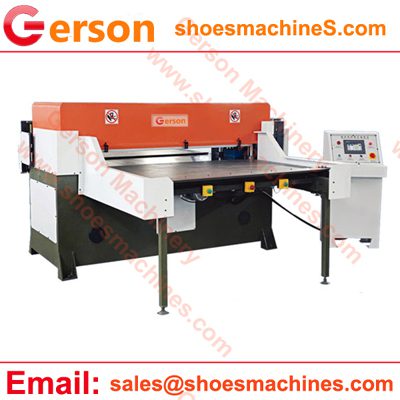
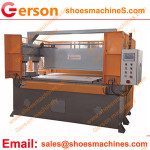
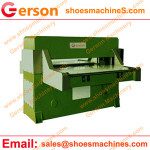
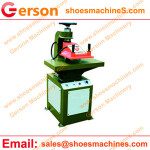
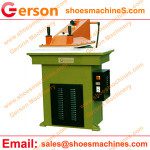
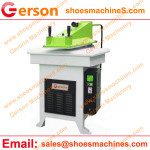
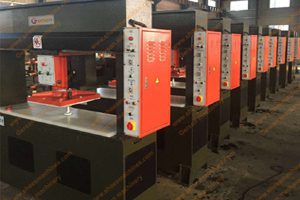
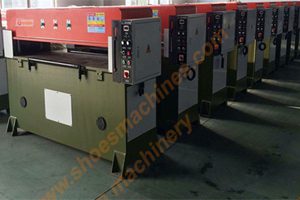
Full Bridge Die Cutter Machine is also know as full head beam press machine is a type of industrial die-cutting press known for its robust construction and high capacity, often featuring a 4-column design. It’s designed to provide accurate and consistent die cutting of various materials, especially high-strength ones, by distributing force uniformly across the cutting area.
Full Bridge Die Cutter Machine
How it Works:
Die: A die is a specialized tool, similar to a cookie cutter, with sharp cutting edges in the desired shape.
Material Placement: The material to be cut (e.g., fabric, foam, rubber, plastic, leather, paper, composites) is placed on a cutting surface.
Pressing Mechanism: The full bridge die cutter uses powerful hydraulics and a four-column design to apply significant, even pressure across the die. This ensures a clean and precise cut through the material.
Double Cylinder and Connecting Rod: Many full bridge die cutters utilize a double oil cylinder and a precise double-crank connecting rod balancing mechanism. This advanced system guarantees that the cutting depth is consistent across all parts of the material, preventing size errors between layers.
Slow Cutting: When the press board comes into contact with the die, it often performs a slow cut to ensure maximum precision and prevent material displacement.
Ejection: After cutting, an ejection system (often involving rubber strips on the die) helps to remove the cut piece without damage or sticking.
Key Characteristics and Advantages:
High Capacity: Can handle significant cutting forces, often up to 200 tons or more, making them suitable for demanding industrial applications.
Precision and Consistency: The robust design and advanced balancing mechanisms ensure uniform force distribution and consistent cutting depth, leading to highly accurate and repeatable results.
Versatility: Capable of cutting a wide range of non-metallic materials, and sometimes even thin metals.
Efficiency: Designed for industrial processes that require precision in large volumes, optimizing production.
Durability: Built with robust components and often feature automatic lubrication systems to ensure long service life.
Control System: Type of control system (e.g., PLC – Programmable Logic Controller) and its capabilities.
User Interface: Touchscreen interface, push buttons, etc., and ease of programming.